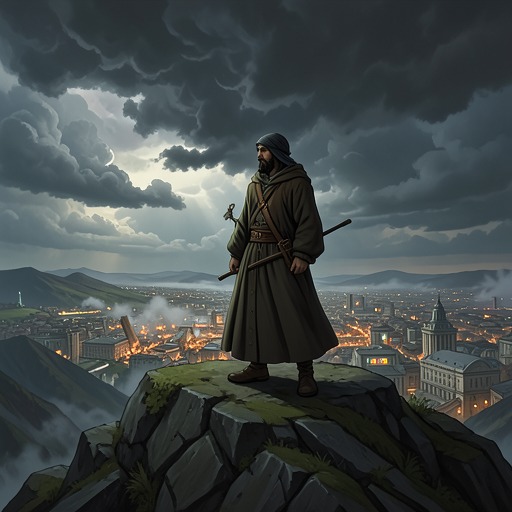
Hamza
The Satanic VersesHamza is Mahound’s uncle, a veteran fighter whose reputation for courage is at once genuine and carefully embellished. He serves as a soldierly source of counsel within Mahound’s circle: when Mahound returns troubled by Abu Simbel’s offer, Hamza recognizes the change in him and urges him to seek Gibreel. After Mahound recites the verses that he later repudiates, Hamza’s unease turns toward action. On the night of Jahilia’s festival, he searches the city and comes upon an attack on his friends, drawing the sword he had kept sheathed since his conversion.
Identity and reputation
At sixty, Hamza remains known as Jahilia’s foremost fighter and lion-hunter. The novel qualifies this martial legend: he has been defeated in combat more than once, and friends or fortunate chances have saved him. He can also use his money to keep such episodes out of public view. Age and survival have nevertheless strengthened his standing. His reputation is not simply a record of victories; it is a story that has grown around the fact that he has endured.
That gap between legend and experience shapes his presence. Hamza does not speak as an infallible warrior. He knows both the force and the limits of his own reputation, and his judgments carry the weight of a man who has survived dangers without always mastering them. His courage is visible less in an unbroken record than in his willingness to face danger again.
Counsel at Zamzam
Hamza appears with Bilal, Salman the Persian, and Khalid at Zamzam Well, where Mahound’s followers wash and pray. When Mahound has been gone for hours, Khalid fears that Abu Simbel is torturing him. Salman suspects a more covert danger, while Bilal insists on his faith in Mahound. Hamza checks Khalid’s alarm, reminding him not to let Mahound see his fear. He also corrects Bilal’s misplaced certainty: faith, he says, belongs to God, because the Messenger is still a man. His response is both practical and devotional, distinguishing loyalty to Mahound from belief in his invulnerability.
When Mahound returns, Hamza sees that something is wrong. He contrasts the brightness that usually marks Mahound’s descent from Mount Cone with the darkness he sees now, then listens as Mahound describes Abu Simbel’s proposal: recognition for Submission and a seat on the Council of Jahilia in return for approval of Lat, Uzza, and Manat. Hamza does not attempt to decide the theological question for his nephew. As Mahound’s fatigue and uncertainty deepen, he cups his face and tells him that the others cannot resolve the matter in his place: he must climb the mountain and ask Gibreel.
The advice places Hamza beside, rather than above, Mahound’s crisis. Salman warns that the offer could make Mahound appear false, while the narrative presents Mahound’s experience of revelation as an intimate and uncertain act of listening. Hamza’s recommendation acknowledges that the decision belongs to Mahound, even as it directs him toward the source he believes can answer. The later account complicates that confidence: Mahound comes to identify the earlier recitation as satanic, while Gibreel’s narration says that the same voice produced both the verses and their repudiation. Hamza’s counsel is therefore situated within a story that refuses an easy separation between revelation, doubt, and the voice that delivers them.
The festival and the attack
After the recitation, Hamza walks home alone in the subdued aftermath of what the narrative calls a triumph. He sees a gigantic scarlet Manticore poised above him on the city battlements. The apparition vanishes as he turns, and the laughter of people returning from the fair offers an ordinary explanation for the uncanny night: Jahilia is filled with revelers in animal and fantastic masks. Hamza nonetheless returns home for his battle sword. He has not worn it since converting through his nephew, but now judges that peace must wait.
The setting makes his decision more than a return to an old habit. The festival’s gold-lit streets are full of singing, drinking, and revelry, while Hamza searches away from the crowded celebration, through the shadows, for the Manticore he believes is loose. The city’s masquerade blurs the boundary between costume and threat; his earlier vision has disappeared, but it has not quieted his sense of danger.
After hours of searching, Hamza finds a red Manticore at a dark corner of the outer walls, where Khalid, Salman, and Bilal are under attack by masked assailants. He recognizes his friends and charges in with his sword. The narrative calls him a lion in this moment, reversing the earlier image of the aging fighter whose legend outstrips his record. Now his courage is not a tale protected from the facts of combat: it is a decision to intervene while his friends are in danger. The account ends with his rush toward the attackers, without giving the outcome of the fight.
Narrative role
Hamza connects religious uncertainty to bodily risk. At Zamzam, he steadies Mahound’s anxious followers and refuses to confuse a messenger with God; later, he sees Mahound’s distress and directs him toward Gibreel rather than claiming authority to settle it. On the festival night, the same loyalty becomes physical defense. His sword, long kept sheathed after his conversion, marks the shift from counsel to action.
His characterization also holds public myth against private vulnerability. The celebrated fighter has known defeat and rescue, yet neither qualification cancels his capacity for courage. The Manticore episode extends that tension into the novel’s uncertain terrain, where a vanished vision, a city of masks, and an attack on real companions meet in one sequence. Hamza’s significance lies not in solving the mystery of what is seen or heard, but in how he responds: with measured counsel when Mahound must choose, and with immediate solidarity when his friends are threatened.